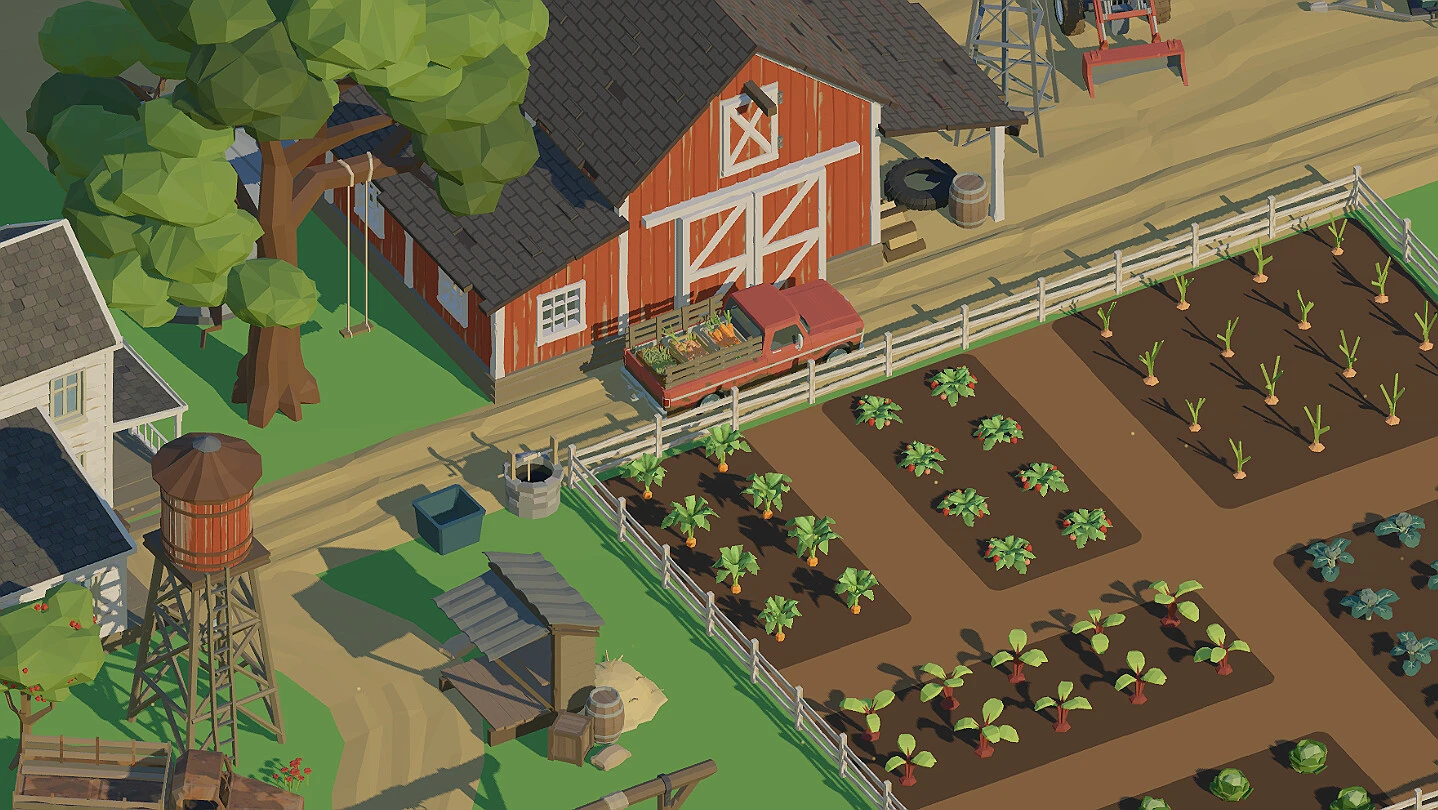
- Farm to Fortune Steam centers on planting crops, harvesting them, and selling stock through your farm shop.
- Core progression comes from reinvesting sales into better tools, faster growth, and additional fields.
- Best session style is relaxed play where short visits still move the farm forward.
- First priority should be a steady upgrade cycle instead of expanding without improving production.
- Demo option lets you test the farming loop before deciding whether the full experience suits you.
Farm to Fortune Steam Core Loop
Farm to Fortune Steam is a relaxed farming grinder built around a simple progression cycle: plant crops, harvest them, stock the farm shop, and reinvest each sale into improvements. The main appeal is watching a small plot gradually become a larger, more efficient operation without demanding constant attention or fast reactions.
Video Highlights:
- The opening farm begins with a small plot and limited production capacity.
- Harvest sales support better tools, faster growth, and additional fields.
- The game is designed around calm sessions rather than urgent objectives.
- Progress feels meaningful even when you only play for a short visit.
- The farming loop is intentionally focused on steady numerical growth.
The most important idea is the reinvestment loop. A harvest is not just a finished task; it is funding for the next improvement. Better tools can make later harvests more productive, while faster growth shortens the time between planting and selling. New fields then give the entire operation more room to scale.
| Core Action | Immediate Result | Long-Term Purpose |
|---|---|---|
| Plant crops | Starts a production cycle | Creates future shop stock |
| Harvest crops | Collects farm output | Converts growing time into inventory |
| Stock the shop | Makes products available for sale | Generates money for upgrades |
| Buy better tools | Improves the farming process | Supports faster progression |
| Unlock new fields | Expands available space | Increases the farm’s growth ceiling |
Treat every action as part of one cycle: production creates sales, sales fund upgrades, and upgrades improve the next production cycle. Avoid looking at expansion as a separate goal from efficiency.
Plant
Begin the next growth cycle as soon as your available plot is ready. Consistent planting keeps the farm moving forward.
Sell
Move harvested goods into the farm shop so production becomes usable income rather than idle inventory.
Reinvest
Spend earnings on improvements that make future harvests faster, easier, or larger in scope.
How to Build Early Farm Progression
The early game is best understood as a balance between immediate output and future efficiency. A tempting expansion may make the farm look larger, but a better tool or faster growth can improve every cycle that follows. Use the upgrade path to create a dependable snowball rather than spending purely for appearance.
The available progression themes can be grouped into three practical categories:
| Upgrade Focus | What It Changes | When It Matters Most |
|---|---|---|
| Better tools | Improves the effectiveness of farm work | When repeated actions begin to feel like the main time cost |
| Faster growth | Reduces the waiting period before harvest | When your plot is active but progress feels slow |
| New fields | Provides more space for production | When existing capacity is being used consistently |
A reliable early approach is to improve the part of the loop that limits your next sale. If crops are ready quickly but handling them slows you down, prioritize tools. If you regularly wait for growth, faster production may offer more value. If your farm is efficient but lacks capacity, begin saving toward a new field.
Establish a Repeatable Plot
Use the starting space to learn the timing of planting, growth, harvesting, and shop stocking. The goal is not maximum size immediately; it is a routine you can repeat without confusion.
Identify the Current Bottleneck
Notice whether your progress is limited by farm work, crop growth, or available space. Match your next investment to that restriction rather than choosing upgrades randomly.
Reinvest the Next Sale
Put new earnings back into an improvement that affects future cycles. This keeps the farm’s income and efficiency connected.
Expand After Efficiency Improves
Add new fields once your current operation is producing consistently. Expansion is more useful when the farm can support it with a stable upgrade rhythm.
The strongest general pattern is efficiency first, capacity second. A larger farm becomes more valuable when your tools and growth speed can support the additional workload.
| Situation | Recommended Focus | Reason |
|---|---|---|
| Harvests feel slow to manage | Better tools | Reduces friction in repeated farm actions |
| The plot spends too long waiting | Faster growth | Shortens the delay before another sale |
| The farm feels efficient but cramped | New fields | Adds room for the established production loop |
| You play in short sessions | Consistent small cycles | Each visit can still produce visible progress |
| You are unsure what to buy | Upgrade the clearest bottleneck | Keeps spending tied to a measurable need |
Short Sessions and Relaxed Farming
Farm to Fortune is especially suited to players who want a low-pressure routine. The central reward is not a difficult challenge or a demanding schedule; it is returning to a farm that is slightly larger and better organized than before. A ten-minute visit can still matter because the game’s progression is built around repeated improvement.
This makes session planning more useful than rushing. Before leaving, begin the next sensible production cycle and make sure your recent harvest has been converted into shop stock. When you return, you can continue from a clear state instead of spending the opening minutes deciding what was left unfinished.
Quick Visit
Check the plot, harvest ready crops, stock the shop, and make one useful reinvestment.
Longer Session
Review the farm’s bottleneck, complete several production cycles, and work toward the next field or efficiency improvement.
End-of-Session Setup
Leave the farm prepared for the next visit by starting a new growth cycle where possible.
| Session Length | Suggested Routine | Main Benefit |
|---|---|---|
| Short visit | Harvest, stock, reinvest | Preserves steady forward progress |
| Medium session | Repeat the full farm loop several times | Builds income and clarifies upgrade needs |
| Longer session | Combine production with expansion planning | Turns accumulated sales into broader capacity |
The game’s relaxed pacing also helps define what not to expect. The available material presents the experience as a focused farming grinder. Its appeal comes from planting, selling, upgrading, and expanding, so players looking for a large collection of unrelated systems should set expectations accordingly.
Farm to Fortune is presented as a concentrated farming progression game. Its reward comes from watching the farm and its numbers grow, not from constantly introducing new genres or complicated side systems.
Reliable Farm Visit:
- Check which crops are ready to harvest
- Move harvested goods into the farm shop
- Identify the current production bottleneck
- Choose one upgrade that improves the next cycle
- Start the next growth cycle before leaving
Farm to Fortune Upgrade Priorities
Choosing an upgrade is easier when you separate short-term convenience from long-term scaling. Tools and growth speed generally improve the operation you already have, while new fields increase the amount of space available. Neither category should be treated as automatically superior; the right choice depends on what is currently restricting progress.
Use this priority framework when comparing options:
| Priority | Choose It When | Expected Effect |
|---|---|---|
| Better tools | Farm actions are slowing each cycle | Smoother and more efficient handling |
| Faster growth | Waiting is the main source of downtime | More frequent harvest opportunities |
| New fields | Current space is fully supporting the loop | Greater production capacity |
| No immediate purchase | The next upgrade is unclear | Preserve flexibility until the bottleneck is visible |
A common mistake is expanding before the existing farm is ready. New space can look like obvious progress, but unused capacity does not create value by itself. If the current plot is still waiting on slow growth or inefficient tools, improving that weakness may make the next expansion more productive.
Another mistake is saving indefinitely for a large upgrade while ignoring smaller improvements that would accelerate the journey. The better approach is to compare the next purchase with the next few production cycles. If a modest improvement helps the farm generate income more smoothly, it may be the better bridge toward a larger field.
Before buying, ask one question: what currently prevents the next sale from happening sooner? The answer should guide your upgrade choice more often than the visual appeal of a larger farm.
| Upgrade Decision | Avoid This Approach | Better Approach |
|---|---|---|
| Tool improvement | Buying without noticing workflow friction | Confirm that repeated farm actions are slowing progress |
| Growth improvement | Ignoring waiting time | Choose it when crop timing limits your next sale |
| Field expansion | Opening space that cannot be supported | Expand after the current loop is stable |
| Savings plan | Holding every coin without a purpose | Save toward a clearly identified next milestone |
Demo Check and First-Session Goals
A demo is a practical way to determine whether the core loop matches your preferred play style. The available discussion identifies free demos as an option for trying the three featured games in one evening, including Farm to Fortune. For this title, focus on whether planting, harvesting, selling, and reinvesting feel satisfying over repeated cycles.
During a first session, do not judge the game only by how quickly the opening plot expands. Pay attention to the rhythm between actions. Does each return to the farm feel productive? Do upgrades make the next cycle more efficient? Is the quiet pace comfortable, or would you prefer a game with more active objectives?
| First-Session Check | What to Observe |
|---|---|
| Production rhythm | Whether planting and harvesting create a comfortable routine |
| Shop loop | Whether selling feels like a meaningful step in progression |
| Upgrade feedback | Whether tools or faster growth make the next cycle feel improved |
| Expansion appeal | Whether unlocking additional space is a motivating goal |
| Session flexibility | Whether short visits still feel worthwhile |
Play long enough to repeat the core loop several times. The game’s appeal is cumulative, so one isolated harvest may not show how satisfying the full upgrade cycle feels.
The strongest fit is a player who enjoys incremental growth, low-pressure management, and visible improvement over time. Farm to Fortune may be less suitable if you need constant combat, complex narrative decisions, or a large variety of unrelated activities. Its identity is clear: build a small farm, improve its process, and watch the operation snowball.
Q: What is the main gameplay loop in Farm to Fortune Steam?
The core loop is planting crops, harvesting them, stocking the farm shop, earning sales, and reinvesting those earnings into better tools, faster growth, and new fields.
Q: What should I upgrade first in Farm to Fortune?
Start by identifying your current bottleneck. Better tools suit farms slowed by repeated actions, faster growth helps when waiting is the main issue, and new fields are most useful once the current operation is running consistently.
Q: Is Farm to Fortune suitable for short play sessions?
Yes. Its relaxed progression means a short visit can still include a harvest, a shop sale, and a useful reinvestment. Each return can leave the farm slightly more developed.
Q: Can I try Farm to Fortune before committing to the full game?
The available discussion identifies a free demo as an option for trying the game. Use the demo to test whether the repeated farming and upgrade cycle matches your preferred pace.