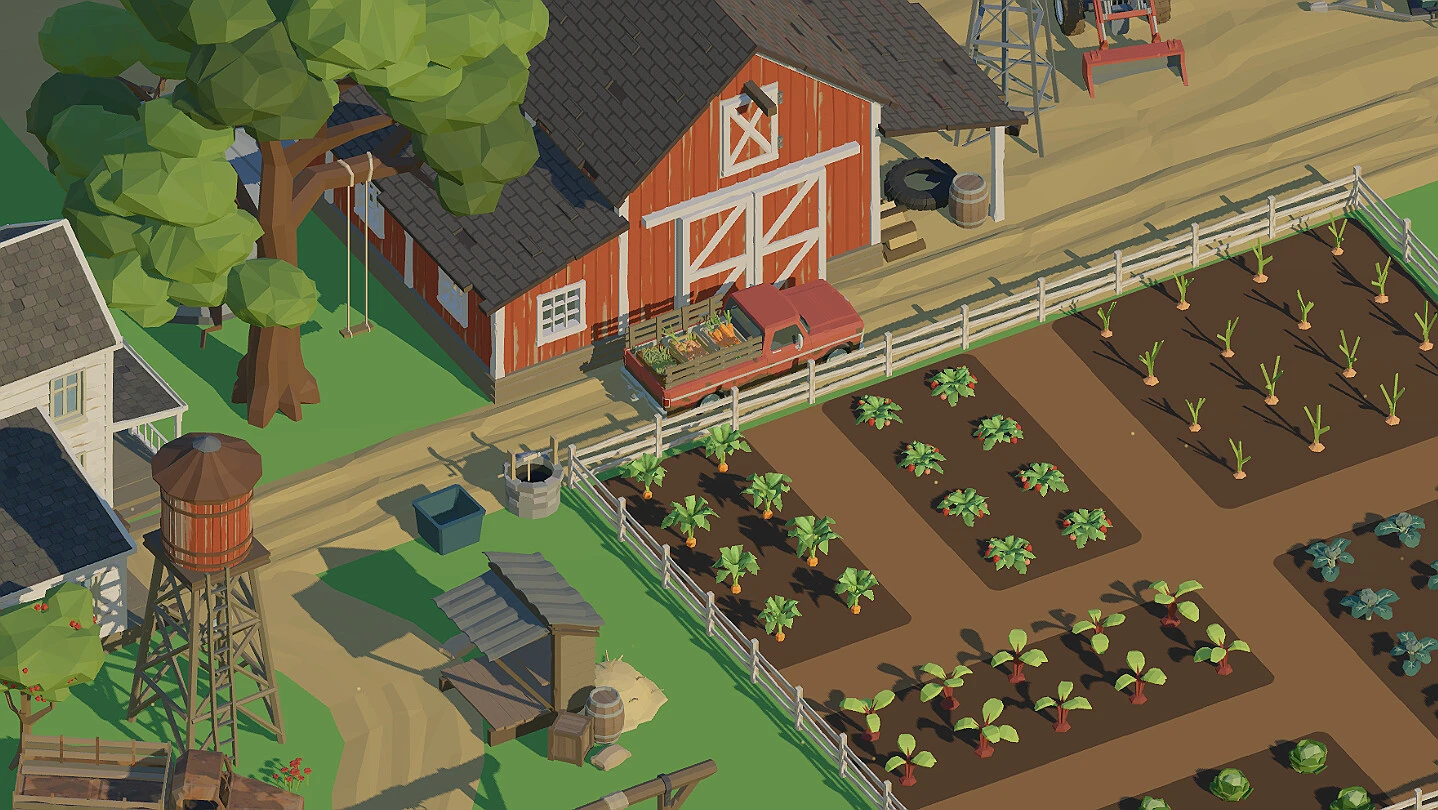
- Farm to Fortune relaxing game focuses on planting, harvesting, selling, upgrading, and expanding at a comfortable pace.
- Start small by keeping your available plots productive before spending heavily on expansion.
- Reinvest carefully in tools, production efficiency, growth speed, and upgrades used during every farming cycle.
- Choose crops by stage: fast cycles support early cash flow, while higher-value crops suit an established farm.
- Use the Demo to test the core farming loop before committing to the full Steam release.
Farm to Fortune Relaxing Game: Core Loop
Farm to Fortune relaxing game is a Steam farming simulator built around a calm production loop rather than constant pressure. You prepare available farmland, plant crops, wait for growth, harvest the results, sell your produce, and use the proceeds to improve the farm. The most reliable early strategy is to repeat this cycle consistently instead of spending the entire starting balance on one large purchase.
The game is designed around gradual progress. New players can focus on learning how the farm works, while experienced players can optimize crop timing, shop purchases, tool upgrades, and land expansion. The relaxing pace also makes it suitable for short sessions, background play, and longer planning sessions where each purchase supports the next production cycle.
| Core Activity | Main Purpose | Beginner Priority |
|---|---|---|
| Planting | Convert available plots into future income | High |
| Harvesting | Collect completed crops | High |
| Selling | Turn produce into usable funds | High |
| Upgrading | Improve efficiency or production | Medium to high |
| Land expansion | Increase long-term capacity | After stable income |
Steady Production
Keep usable farmland active whenever you have affordable crops available. Consistent cycles usually matter more than a single ambitious investment.
Measured Spending
Save enough currency to continue planting after making a purchase. A useful upgrade should support production rather than interrupt it.
Comfortable Progression
Move through objectives, shop access, tools, and land expansion at a pace that matches your current income and available capacity.
Treat each harvest as part of a repeatable routine. The goal is not to spend every coin immediately, but to keep the farm productive between upgrades.
Step-by-Step Beginner Route
The best opening route establishes a dependable income stream before focusing on larger purchases. Follow the sequence below to avoid leaving plots unused or expanding before the farm can support its new capacity.
Use the Starting Farmland
Begin with the plots already available. Plant crops you can afford and avoid committing your entire starting balance before the first harvest. Keeping some funds available gives you flexibility for the next cycle and early objectives.
Harvest and Sell the First Cycle
Return when the crops are ready, collect the harvest, and sell the produce through the available shop or selling flow. This converts the opening work into funds for continued production.
Choose One Practical Upgrade
Prioritize an upgrade that improves an action you perform regularly, such as planting, harvesting, growth, output, or general efficiency. Avoid purchasing several minor improvements if doing so delays another profitable cycle.
Maintain a Repeatable Routine
Keep available plots productive while checking current objectives and shop options. A steady loop creates a stronger foundation than rushing toward every visible unlock.
Expand After Cash Flow Stabilizes
Purchase additional land when your current plots are used consistently and you can afford to support the added space. Expansion is most valuable when new land can be put to work quickly.
| Stage | Main Action | Spending Rule | Progress Signal |
|---|---|---|---|
| Opening | Plant affordable crops | Keep part of the starting balance | First plots are active |
| First harvest | Collect and sell produce | Reinvest only after selling | A repeatable income cycle begins |
| Early development | Buy a useful upgrade | Favor repeated actions | Farming becomes more efficient |
| Expansion preparation | Save for land or tools | Avoid empty-capacity purchases | Existing plots stay productive |
| Larger farm | Use additional land | Match expansion to production | More space supports higher output |
Do not treat new land as an automatic priority. If existing plots are not being used consistently, expanding can create unused capacity instead of better income.
Crop Planning and Upgrade Priorities
Crop selection should reflect your current farm stage. A fast-growing crop can help establish early cash flow because it returns funds more frequently. A balanced crop can support steady development, while a higher-value crop becomes more attractive when you have enough space and savings to tolerate a longer production interval.
Because confirmed crop names, prices, and growth values are not established in the supplied information, use the categories below as a planning framework rather than a fixed profit ranking. Check in-game values before committing to a large planting route.
| Crop Strategy | Cycle Profile | Best Use | Main Trade-Off |
|---|---|---|---|
| Fast-cycle | Shorter growth interval | Early cash flow and frequent reinvestment | Lower value per individual sale |
| Balanced | Moderate growth and value | Developing farms with regular activity | Less specialized than other options |
| High-value | Longer wait with stronger sale potential | Established farms with extra capacity | Slower return between sales |
Early Priority
Tools and production efficiency are useful when they affect actions repeated during nearly every planting and harvesting cycle.
Midgame Priority
Growth speed and yield become more valuable once enough plots are active to benefit from improved production.
Late Priority
Shop improvements and land expansion support larger operations after income and production are stable.
| Upgrade Category | When to Consider It | Why It Matters |
|---|---|---|
| Tools | When a repeated action feels inefficient | Improves the routine you perform most often |
| Production efficiency | After the first profitable cycles | Helps preserve momentum between harvests |
| Growth speed | When multiple plots are active | Reduces downtime across the farm |
| Yield improvements | When regular production is established | Increases the value of active farmland |
| Land expansion | After stable cash flow | Adds capacity without forcing an early spending reset |
A good upgrade path follows frequency of use. If an improvement affects planting, harvesting, growth, or selling during every cycle, it generally deserves earlier consideration than an option that only helps occasionally. However, always preserve enough currency to continue farming after the purchase.
Prioritize upgrades that improve activities you perform repeatedly. A modest improvement used every cycle can be more useful than an expensive purchase that benefits only an occasional action.
Progression, Weather, Tasks, and Achievements
Farm progression works best when you connect daily production with broader objectives. Check tasks while maintaining your crop routine, use the shop when new options become available, and save larger purchases for moments when they support the farm’s next milestone.
Weather should be treated as a system to observe rather than something to ignore. Track whether changing conditions affect growth, timing, or task requirements in your current version. Since weather details can change with updates, verify the effect in-game before building a rigid route around it.
| Progression Area | Practical Approach | What to Track |
|---|---|---|
| Tasks | Complete current objectives alongside normal farming | Requirements, rewards, and unlocked features |
| Shop | Review available purchases after profitable cycles | Tools, production options, and expansion costs |
| Weather | Observe changes during active crop cycles | Growth impact and timing changes |
| Achievements | Follow normal progression before cleanup | Farming, shop, upgrade, and expansion milestones |
| Updates | Recheck systems after patches | Balance changes, new content, and fixes |
Progression Checkpoints:
- Use the starting farmland and complete the opening objectives
- Establish a repeatable planting, harvesting, and selling routine
- Review shop options before making large purchases
- Upgrade tools or production systems that support regular activity
- Expand land only when the additional space can be used productively
The achievement route should normally follow natural farm development. Early farming milestones can be completed while learning the opening loop. Crop and production milestones follow through regular planting and harvesting. Shop and upgrade achievements become easier to track after income is stable, while land expansion milestones belong later in the progression.
The Steam listing and its community areas are the best places to check current release information, patch changes, and player discussions:
Task requirements, weather behavior, achievement details, and upgrade balance may change with updates. Confirm the current in-game behavior before relying on an older route.
Demo, Play Style, and FAQ
The dedicated Demo is a practical way to test the core farming loop before moving into the full progression experience. Use it to decide whether the planting, waiting, harvesting, selling, and upgrading rhythm fits the relaxed play style you want.
The full Steam version is intended for the broader progression from initial farmland toward a larger operation. Store information such as price, discounts, release details, system requirements, languages, controller support, and cloud saves should be checked on the current listing because those details can change.
| Version or Feature | Best For | Check Before Playing |
|---|---|---|
| Demo | Testing the basic farming loop | Current availability and included content |
| Full version | Longer progression and expansion | Current store status and edition details |
| Widget Mode | Background or low-interruption play | How the mode fits your preferred setup |
| Steam Community | Questions and player discussion | Current reports and update context |
Q: What makes Farm to Fortune a relaxing game?
Its main loop is based on planting, waiting for growth, harvesting, selling, and gradual reinvestment. You can focus on steady progress instead of rushing every decision.
Q: What should I do first in Farm to Fortune?
Use the starting plots, plant affordable crops, complete the first harvest, sell the produce, and reinvest in one practical upgrade before expanding.
Q: Which crops are best for beginners?
Fast-cycle crops are generally useful for establishing early cash flow, while balanced crops can support a developing farm. Check current in-game growth and sale values before choosing.
Q: When should I expand my farm?
Expand after your current plots are used consistently and your income can support additional space. New land is most useful when you can put it into production quickly.
Play for consistency: keep plots active, sell completed harvests, choose upgrades by frequency of use, and expand only when the farm is ready.