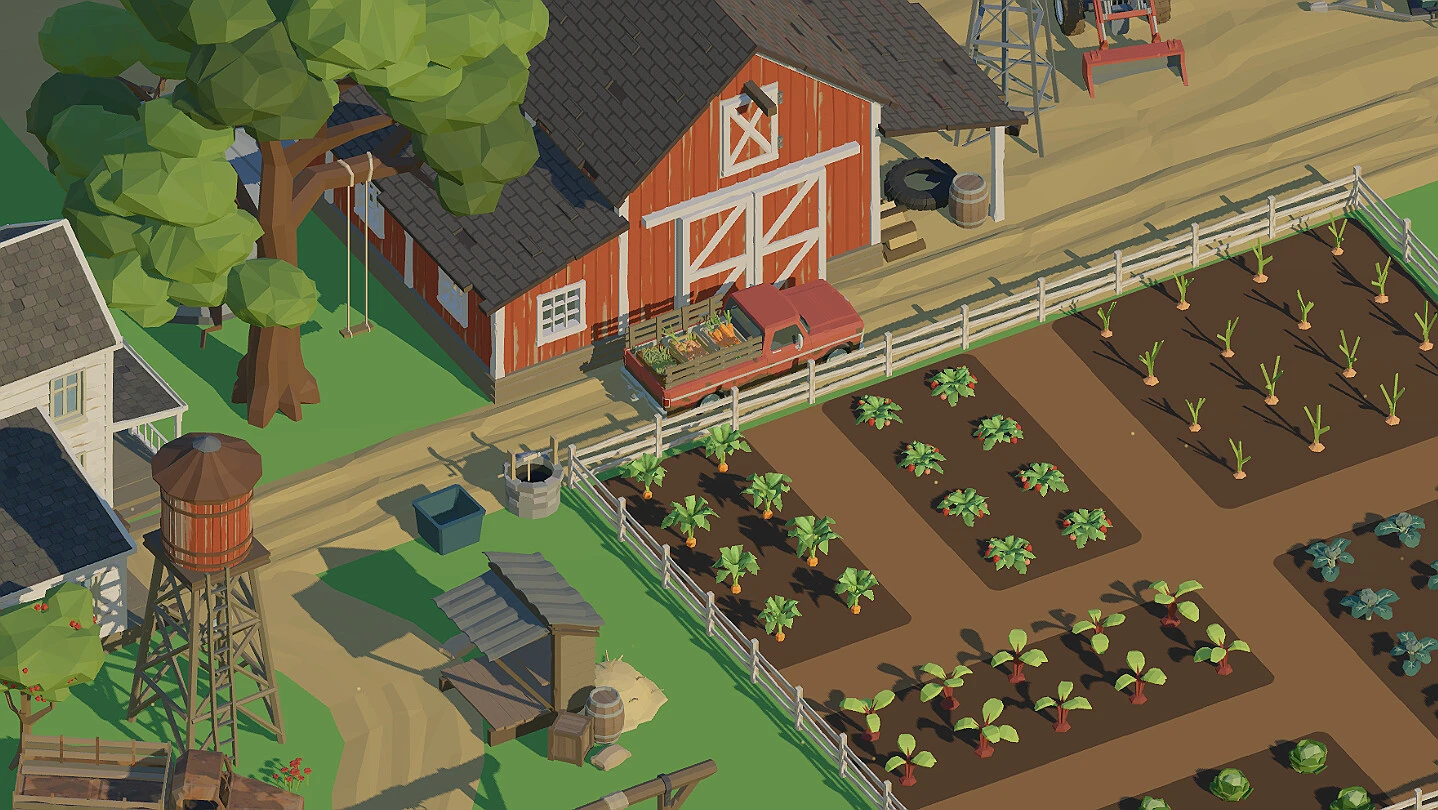
- Farm to Fortune how to play starts with plowing, planting, watering, harvesting, and selling.
- Grass provides a low-risk opening crop while you learn the farm cycle.
- Wheat, carrots, and strawberries offer stronger earning opportunities as they unlock.
- Upgrades improve tools, watering coverage, growth speed, storage, and market performance.
- Expansion becomes more important once your crop rotation and income are consistent.
Farm to Fortune how to play: Core Loop
Farm to Fortune is a farming and progression game built around repeating a simple production cycle. You prepare garden plots, plant seeds, maintain crop growth, harvest the results, and sell them through the market stall. The best opening strategy is to build a reliable routine before spending heavily on upgrades or expensive seeds.
The early game rewards attention more than complicated planning. Start with the tools already available, learn how watering affects the growth timer, and keep the farm moving while crops mature. Clearing plant remnants is also part of the cycle because used plots must be prepared again before they can support another crop.
Video Highlights:
- Plowing and preparing the first ten-tile plot
- Planting grass, watering crops, and checking growth progress
- Selling the first harvest to fund seeds and improvements
- Unlocking wheat, carrots, strawberries, onions, and apple trees
- Comparing active crops with passive tree income
| Farm Action | What to Do | Why It Matters |
|---|---|---|
| Prepare | Select the hoe or plow and clear usable plots | Creates space for new crops |
| Plant | Choose seeds from the inventory and place them in prepared soil | Starts the production cycle |
| Water | Fill the watering tool and cover planted plots | Allows the growth timer to begin |
| Harvest | Use the appropriate harvesting tool when crops mature | Converts planted crops into inventory |
| Sell | Move harvested goods to the market stall | Generates coins for the next cycle |
| Reset | Clear remnants and prepare the plot again | Keeps the farm productive |
The most important visual clue is the growth timer. If the timer has started, the crop is progressing, even when the watering state is not obvious. This makes the timer more useful than repeatedly watering the same patch.
Treat the first few harvests as setup money. Grass is useful for learning the loop, but your longer-term goal is to unlock crops with stronger sales value and improve the tools that reduce daily effort.
Step-by-Step Farm Setup
Use this sequence whenever you begin a new crop cycle. It keeps the farm organized and prevents wasted movement between the shop, plots, watering area, and market stall.
Prepare the plot
Select the hoe or plow and work every available tile. After harvesting, remove plant remnants before attempting to sow again. A clean plot is the foundation of each cycle.
Buy and plant seeds
Open the shop and choose seeds that fit your current budget. Plant the full usable area when you can afford it, but keep enough coins available for the next cycle.
Water efficiently
Fill the watering tool before covering the farm. Watch for the growth timer to start. If rain appears, check the crop state before spending extra water.
Harvest at maturity
Use the correct tool and collect ready crops as soon as practical. Crops can mature unevenly, so inspect each plot instead of waiting for every tile to finish together.
Sell and reinvest
Send harvested goods to the market stall, then decide whether the next purchase should be seeds, a tool upgrade, a plot expansion, or a market improvement.
| Stage | Beginner Priority | Common Mistake |
|---|---|---|
| Plot preparation | Clear every used tile | Leaving remnants on harvested soil |
| Seed purchase | Match spending to available coins | Buying costly seeds without reserve funds |
| Watering | Confirm the growth timer | Rewatering without checking progress |
| Harvesting | Collect ready crops promptly | Waiting for uneven crops to synchronize |
| Selling | Keep the next cycle funded | Spending all earnings on one upgrade |
A productive farm does not need every tile to mature at exactly the same moment. Staggered harvests can keep the market active and give you regular income. However, if your plots become too uneven, consider planting one crop type across a larger area to simplify timing.
Do not spend your entire balance on upgrades if you cannot afford the next seed purchase. A modest crop rotation is usually better than an improved tool sitting beside empty plots.
Crop Choices and Profit Progression
Crop progression is one of the main reasons to keep reinvesting. Grass is a safe introduction because it can be planted early and helps establish the basic harvest-and-sale rhythm. Wheat then offers a stronger return, while carrots and strawberries provide additional options as the shop expands.
The right crop depends on more than sale value. Seed cost, growth time, watering demands, and your available plot space all matter. A crop with a higher selling price may still be inconvenient if it consumes most of your funds or matures too slowly for your current setup.
| Crop or Product | Best Use | Management Notes |
|---|---|---|
| Grass | Early learning and low-risk rotations | Useful while building your first funds |
| Wheat | Stronger early progression | Prioritize after learning the basic farm loop |
| Carrots | Mid-progression crop option | Helps support upgrade requirements |
| Strawberries | Higher-value crop rotation | Watch uneven ripening across plots |
| Onions | Later crop and upgrade support | Keep some available when objectives require them |
| Apples | Passive income option | Trees can provide income without regular watering |
A good progression pattern is to use a dependable crop for working capital, then reserve a portion of profits for better seeds. This avoids the trap of selling everything once and having no resources for the next planting.
Low-Risk Rotation
- Start with grass
- Keep seed spending controlled
- Focus on learning watering and selling
Growth Rotation
- Add wheat and carrots
- Reinvest part of each harvest
- Improve tool speed and water coverage
Value Rotation
- Use strawberries and onions
- Track uneven maturity
- Save for plot and stall upgrades
Passive Rotation
- Add apple trees
- Use spare space for recurring income
- Continue farming active crops nearby
Apple trees are especially useful when you want income that does not require the same watering attention as standard crops. They should not replace active farming completely, but they can make expansion and upgrade saving feel less dependent on constant manual maintenance.
When choosing between seeds and upgrades, protect the next full planting first. Once your farm can fund repeated cycles, invest in faster tools, broader watering, and stronger sales capacity.
Upgrade Priorities and Farm Expansion
Upgrades shape how quickly the farm moves from manual work to efficient production. The most valuable improvements reduce repeated actions: faster hand tools, greater watering coverage, improved watering capacity, faster stall sales, and larger plot space.
Several upgrade effects can work together. Faster tools reduce preparation and harvesting time, while better watering coverage lets you maintain more crops with fewer passes. Market upgrades matter once the farm produces more goods than the starting stall can process comfortably.
| Upgrade Area | Effect on Progression | When to Consider It |
|---|---|---|
| Hand tools | Faster hoeing, raking, pitching, or plowing | Early, because every cycle uses tools |
| Watering | More capacity or wider coverage | When multiple plots need maintenance |
| Growth support | Better moisture retention or growth speed | After your crop rotation is stable |
| Market stall | Faster selling or greater capacity | When harvested goods begin to pile up |
| Shop discounts | Lower seed costs | When frequent seed purchases limit expansion |
| Plot expansion | More planting space | When current plots are consistently productive |
| Compost system | Turns plant waste into a farm resource | When clearing remnants becomes routine |
The compost system adds another reason to clear plots instead of ignoring waste. Plant fibers can be processed, and the resulting compost can support the farm through growth-related effects. Because processing takes time, place plant waste into the bin early rather than waiting until you need the finished resource.
A practical upgrade order is:
- Improve the tools used in every cycle.
- Increase watering capacity or coverage.
- Expand the market stall when sales become a bottleneck.
- Add growth and moisture improvements.
- Purchase additional plots once existing space is being used well.
- Add passive trees and specialized systems as your economy grows.
Starter Progress Checklist:
- Prepare and replant every available garden plot
- Sell several harvests without exhausting seed funds
- Unlock wheat, carrots, or another stronger crop
- Purchase at least one tool or watering improvement
- Clear plant remnants and test the compost system
- Add an apple tree or expand the farm when affordable
A larger farm increases earning potential, but it also increases watering, harvesting, and seed demands. Expand after your current plots are producing consistently rather than treating extra land as an automatic upgrade.
Common Mistakes and Long-Term Strategy
The most common early mistake is confusing activity with progress. Constantly changing seeds, buying every visible upgrade, or watering without checking the timer can consume time and coins without improving the next harvest.
Instead, use a repeatable decision process. First ask whether the farm can fund another planting. Then check whether a tool, water, market, or growth upgrade removes a recurring bottleneck. Finally, consider expansion only when the current layout is being used efficiently.
| Mistake | Result | Better Approach |
|---|---|---|
| Spending all coins on upgrades | No money for seeds | Keep a reserve for the next cycle |
| Planting without a plan | Uneven harvest timing | Group similar crops by plot |
| Rewatering blindly | Wasted movement and time | Confirm that the growth timer has started |
| Ignoring remnants | Delayed replanting | Clear harvested tiles immediately |
| Buying too many seed types | Complicated management | Focus on one or two profitable rotations |
| Expanding too early | More work than income | Grow after current plots are reliable |
The demo progression shown in the available gameplay reaches a capped level, so some systems may be limited during the early version. Treat the visible upgrade structure as a practical framework rather than assuming every late-game feature is fully represented.
For players who prefer a relaxed approach, combine passive apple trees with a smaller active crop rotation. For players who enjoy optimization, focus on reducing watering and tool downtime, then synchronize planting across larger plots.
At the end of every harvest, clear remnants, check the shop, review your upgrade target, and plant again before spending the remaining balance.
Q: How do I start playing Farm to Fortune?
Begin by preparing the available plot, planting starter seeds, watering until the growth timer begins, harvesting mature crops, and selling them through the market stall.
Q: What should I plant first in Farm to Fortune?
Grass is a practical opening crop because it supports the first learning cycle. After building funds, move toward wheat, carrots, strawberries, or other crops that fit your budget and available space.
Q: How can I tell whether a crop is watered?
Watch the crop's growth timer. When the timer has started, the crop is progressing. This is more useful than repeatedly applying water without checking the plot.
Q: Should I buy seeds or upgrades first?
Protect the next planting before buying upgrades. Once you can fund repeated crop cycles, prioritize improvements that reduce recurring work, such as faster tools, wider watering coverage, and better market processing.
Farm to Fortune is easiest to understand as a steady production loop: prepare, plant, water, harvest, sell, and reinvest. Start with a manageable crop rotation, use the growth timer as your guide, and expand only when your current plots are paying for the next step.
For the referenced gameplay overview, see THE MOST PROFITABLE FARM IN THE WORLD! | Farm to Fortune.